


The ensemble was created between 1763 and 1765 during the restoration of the church interior following a fire. While the specific architect of these altars and the creators of the statues and decorative elements have not been precisely identified, one can clearly recognize the architectural school of Johann Christoph Glaubitz. This school of Late Baroque plasticity is characterized by its beloved motifs of broken and convex cornices and the rhythm of breaking and merging lines. The two-tier retable of the High Altar rises above a massive platform with a wavy silhouette. In the center is the altar table (mensa) of a traditional Baroque silhouette, moved slightly forward and adorned with a gilded rocaille relief; above it stands a shimmering golden tabernacle of Rococo forms.
The first tier of the retable is dominated by Corinthian columns arranged in a semicircle, whose verticality is echoed by pairs of flat pilasters clinging to the wall of the apse. Four statues of saints are composed before the columns (two figures placed between three angled columns): St. Albert, one of the founders of the Carmelite Order, holding a cross; the Prophet Elijah, associated with the spiritual origins of the order and the first hermits of Mount Carmel; St. Dominic of Jesus Mary, a mystic and prior of the Austrian Discalced Carmelites, holding a burning heart; and St. Angelus Martyr, representing the Carmelites of the Old Rule, with a palm branch. In the center of the first tier hangs the painting The Transverberation of the Heart of St. Teresa by Simon Czechowicz (second half of the 18th century).
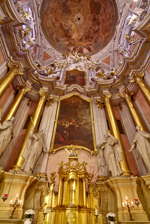
The second tier of the altar is distinguished by unexpected architectural plasticity. The pilasters, which are flush with the retable at the top, completely separate from the wall at the lower cornice dividing the tiers, transforming into freely waving planes. This is an original motif not found in other Late Baroque altar compositions in Vilnius. The dynamic plasticity of the altar is concluded by a composition of Gloria held by the arches of a broken cornice, with a heart surrounded by cloud ridges and cherubs’ heads at its center. Graceful figures of angels lean upon those waving planes that seem to have “lost” their architectural form, reaching their hands toward the central painting, The Most Blessed Virgin Mary with the Infant Jesus and St. Casimir, painted by Kanutas Ruseckas in the first half of the 19th century. The figure of St. Casimir appeared in the iconography of this altar not by chance: the Patron of Lithuania became the Patron of the Lithuanian Discalced Carmelite Province established in 1734.
Through ingenious Late Baroque plasticity, the High Altar of St. Teresa is joined with the side altars of Our Lady of Mount Carmel (The Scapular) and St. Joseph (sometimes also called the altar of St. John of the Cross). The left altar contains a valuable painting of Our Lady of Mount Carmel, likely created in the 18th century; the painting of the Holy Family in the altar of St. Joseph is attributed to the same unknown 18th-century painter. Sculptures of St. Teresa of Avila and St. Joseph are composed in the left altar (Our Lady’s), while the right altar features statues of King David and an allegorical figure of Silence (or Asceticism).