

THE GATE OF DOWN CHAPEL IS OPEN
from 7.00 am to 7.00 pm
ORDER OF HOLY MASS
Monday to Saturday:
9.00 am – at the Gate of Dawn Chapel (in Lithuanian)*
10.00 am – at the Gate of Dawn Chapel (in Polish)
** On the first Friday and Saturday of the month, Masses at 9.00 am and 10.00 am – at St Teresa’s Church.
5.00 pm – at St Teresa’s Church (in Polish)
6.00 pm – at St Teresa’s Church (in Lithuanian)
On Sundays:
9.00 am – at St Teresa’s Church (in Polish)
9.30 am – at the Gate of Dawn Chapel (in Lithuanian)
11.00 am – at St Teresa’s Church (in Lithuanian)
1.00 pm – at St Teresa’s Church (in Polish)
3.00 pm – at St Teresa’s Church for children and young people (in Lithuanian)
OTHER SERVICES
On the first Monday of the month, Masses for the deceased will be held at St Teresa’s Church:
5.00 pm (in Polish)
and 6.00 pm (in Lithuanian)
(donations may be placed in the collection box for the deceased)
On the first Thursday of the month, Masses for benefactors will be held at the Chapel of the Gate of Dawn:
9.00 am (in Lithuanian)
and 10.00 am (in Polish)
On the first Friday of the month, there is adoration of the Blessed Sacrament at St Teresa’s Church:
at 8.30 am (in Lithuanian)
following the 10.00 am Mass (in Polish)
On the first Sunday of the month, there will be adoration of the Blessed Sacrament at St Teresa’s Church:
8.30 am (in Polish)
and 10.30 am (in Lithuanian)
ON THE 16TH OF EVERY MONTH – A minor feast day in honour of the Blessed Virgin Mary, Mother of Mercy, at St Teresa’s Church:
9.00 am – Adoration of the Blessed Sacrament (in Polish)
9.30 am – Rosary (in Polish)
10.00 am – Holy Mass (in Polish)
11.00 am – Adoration of the Blessed Sacrament (in Lithuanian)
11.30 am – Rosary (in Lithuanian)
12.00 pm – Holy Mass (in Lithuanian)
INDULGENCES
The Feast of Our Lady, Mother of Mercy – celebrated over eight days this week, which includes 16 November.
Patron saint of the Church of St Teresa of Ávila – 15 October.
PRIESTS ARE ON DUTY IN THE CHURCH SACRISTY
from 8.30 am to 1.00 pm and from 2.00 pm to 6.00 pm
Break: 1.00–2.00 pm
Information regarding Mass intentions
You can support our parish by making a donation to the following account:
ACCOUNT NAME (Beneficiary): St Teresa’s Parish
, Vilnius ACCOUNT NUMBER: No. LT307300010002452064
SWIFT CODE: HABALT22
REFERENCE (Payment purpose):
Please specify, for example:
1) A donation towards the renovation and upkeep of the church
2) A donation for Holy Mass
Please note that you can always contact the priest by phone on (+370 5) 212 3513 or by email at rastine@ausrosvartai.lt.
PLEASE NOTE!
Live broadcasts of Holy Mass from the Chapel of the Gate of Dawn take place every Wednesday:
9.00 am – in Lithuanian
10.00 am – in Polish
The broadcasts are available on the website www.wilnoteka.lt
and on the Wilnoteka Facebook page https://www.facebook.com/wilnoteka/.
Please join us in prayer!

At the beginning of the 16th century, the people of Vilnius appealed to Alexander, Grand Duke of Lithuania, asking him to allow the city to be surrounded by a wall. At that time, the Tatars frequently raided Lithuanian lands, whilst relations with Rus’ were beginning to deteriorate. By a privilege granted in 1503, Alexander ordered the city of Vilnius to be surrounded by stone fortifications. It is said that the foundation stone was laid at the point where the road led to Medininkai and on – through Oshmiana towards Minsk. After the stone was consecrated, work began on the gate, which was later named the Ostry Gate. It is not known exactly when the fortifications were completed, but by 1522 the entire city was surrounded by a wall.
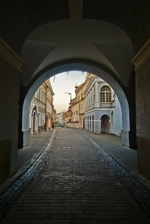
The gate, which today houses the Chapel of Our Lady of Mercy, was first mentioned as the Miednicka Gate in 1514. The name Porta Acialis (Latin), meaning the Sharp Gate, first appeared in 1594. To this day, it is not known why it came to be called this. Lithuanians from the Vilnius area called it the Gate of Blades (Lith. Ašmens vartai). Some speculate that this is linked to the name of the town of Ošmena (Lith. Ašmena), which was then translated literally into other languages (Latin acies, Lith. ašmenys – blades).This is how the name entered Polish and Latin. It is also unknown when and why the gate came to be called ‘Gate of the Dawn’ (Aušros) in Lithuanian. This name may have arisen from a comparison of the Virgin Mary to the Morning Star, or the Dawn.
The image of Our Lady of Mercy was not immediately honoured with a chapel. Initially, the image of the Blessed Virgin Mary hung in a small niche on the inside of the gate, alongside the Saviour of the World on the outer wall. The images were the property of the city. The painting had no chapel or decorations befitting a miraculous image. This remained the case until 1626, when the Discalced Carmelites arrived in Vilnius. They were granted a plot of land near the Gate of Dawn for the construction of a monastery and a church.
The church took a very long time to build and was finally consecrated in 1654. The church is dedicated to the great Spanish spiritual master and reformer of the Carmelite Order, St Teresa of Ávila. The image of the Virgin Mary caught the Carmelites’ attention from the very beginning: they organised devotions around it, thereby fostering the piety of the townspeople. It was not until 1668 that the city authorities officially entrusted the Carmelites with the care of the image of the Virgin Mary, and in 1671, through the efforts of the Carmelite Father Charles of the Holy Spirit, a wooden chapel was erected for it. During construction, the painting was kept in the Church of St Teresa; later, it was solemnly transferred and placed in the chapel.
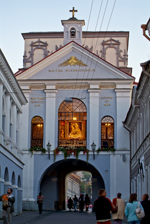
After the wooden chapel burned down in 1711, a brick one was built, which has survived to the present day. In 1829, it took on the features of late Classicism. The chapel was built so that worshippers praying before the painting could stand on the street. The chapel could only be entered from the side of the monastery gardens; lay people, particularly women, were not permitted to enter. During the renovation in 1828–1829, the side windows were extended down to floor level. In 1785, street trading was banned during prayers at the Gate of Dawn. Furthermore, pedestrians, regardless of their religion, were required to walk from the gate to the Pocius Chapel without head coverings.
In 1844, the Carmelites were expelled for aiding the insurgents. The monastery building was handed over to the Orthodox Church, and the chapel was transferred to the diocesan clergy. Since then, it has been open to the public. Even before the chapel was opened, between 1789 and 1799, a gallery with internal stairs for the congregation was added, designed by Pietro de Rossi. It is a classical, two-storey structure with a closed upper gallery and an open lower one. Initially, the upper arcade of the gallery was also open. During renovation work in 1830, the old wooden balustrades were replaced with brick parapets, and the openings were glazed. A staircase was built inside the gallery. Now the organ stands in the upper gallery (it was previously situated on either side of the altar), and the gallery itself is connected to the chapel.
The gatehouse and chapel were restored in 2002.
Compiled from texts published by the Catholic Internet Service concerning John Paul II’s pilgrimage project.