

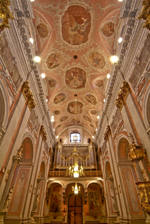
The wall paintings of the Church of St. Teresa in Vilnius are the only surviving work of such wide-reaching ambition from the artistic heritage of the former Lithuanian Province of Discalced Carmelites. The history of their creation is linked to a fire that broke out on Gate of Dawn Street in 1760; following this, through the efforts of the monks, the church was repaired and decorated with frescoes by 1763. The painting of the main nave walls was completed in September 1763, and the vaults and walls of the side chapels were likely decorated the following year. It is believed that the frescoes were painted by Motiejus Sluščianskis.
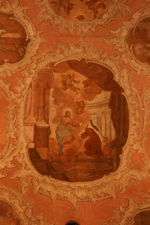
Eighteen scenes of the life of St. Teresa on the church nave vault, eight on the walls, dozens of saintly depictions in the archivolts of the side naves, six illusionistic altars, and nine emblematic compositions reflect the spirituality of the order and the life of its holy foundress. The painter who decorated the Vilnius Discalced Carmelite church drew inspiration from Arnold van Westerhout’s 18th-century engraving cycle, Vita Effigiata della Serafica Vergine S. Teresa di Gesu, which consists of over sixty engravings accompanied by brief Latin commentaries.
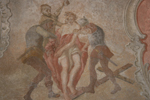
While the life of the saint is graphically depicted in the aforementioned book for sequential study—observing all the chronologically arranged images one by one—the images adorning the church walls and vaults break free from this linear narrative structure into a pulsating series of story-driven and symbolic moments. The consistent “horizontal” narrative is replaced here by a staging of the impression, where the meaningful weight of the images yields to the movement of the sanctuary’s architectural structure and the symbolism inherent within it.