

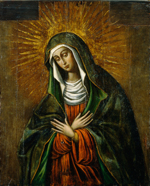
Various opinions have been expressed regarding the origin of the Icon of Our Lady of the Gate of Dawn. At one time, it was believed to be very ancient—thought to be a Byzantine Orthodox icon brought to Lithuania by the Grand Duke Algirdas in 1363. In the 19th century, this legend provided a pretext for the Russian authorities to attempt to seize the Icon from the Catholics. However, fearing unrest, the foreign administration ultimately left it untouched. Modern research indicates that the Icon was created around 1620–1630, modeled after the work of the late 16th-century Netherlandish painter Marten de Vos, most likely based on an engraving by Thomas de Leu from 1580.
The painting (200x162x2 cm) is executed on an oak panel composed of eight joined boards. The layer of paint was applied over a very thin layer of chalk ground, which is a characteristic feature of the Northern European painting tradition. The artistic style and nature of the work suggest that the Icon was created in Vilnius.