

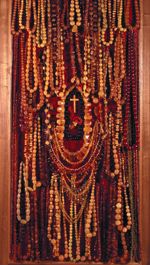
Votive offerings (voti) are signs of gratitude offered by the faithful. They stand as testimonies to the graces received through the intercession of the Mother of Mercy. Many of these votives are very simple – small hearts, figures of people in prayer, or representations of eyes, hands, and feet. The first known votive was offered in 1671. It is said to have been a tablet depicting a miraculous event: the rescue of a child from death. Although that specific votive was destroyed in one of the many fires that ravaged Vilnius, there must have been even earlier tokens of gratitude; the story suggests that when the parents of the boy sought help from Our Lady of the Gate of Dawn, they were following a well-known and trusted tradition in the city.By the end of the 18th century, the number of votives was so vast that in 1799, the Discalced Carmelites were able to use 51 silver votives from the altar to gild and silver the new antependium (the decorative shield covering the front of the altar). In 1808, 37 silver votives were used to craft a pacifical (a liturgical cross) for the chapel. In 1810, as many as 100 likely “old” 18th-century votives were repurposed to create various liturgical vessels.
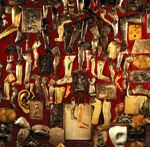
The collection of votives continued to grow. They were hung not only near the Icon but across the entire altar. A description of the chapel from 1844 states that there were 306 votives attached to copper plates on the four altar columns, 402 hanging directly on the altar, and 77 various medals, rings, and other items – totaling 785 pieces. By 1856, the count reached 1,438. Precise records kept between 1884 and 1927 show that 2,539 votives were offered during those forty-four years. The number of offerings notably increased during periods of great upheaval and war (such as 1903–1906 and 1911–1914).

Today, the chapel’s treasury also preserves commemorative gifts, mostly left by groups of pilgrims from abroad. These are not only testimonies of personal graces but expressions of deep respect and devotion to the Mother of God. Many people offer votives not only after experiencing what they recognize as physical miracles—such as healing from a grave illness or a wondrous escape from danger—but also for the spiritual aid and consolation found at the Gate of Dawn: strength in spiritual combat, the conversion of loved ones, or the gift of wisdom in times of difficult choices.