

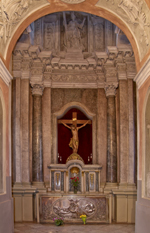
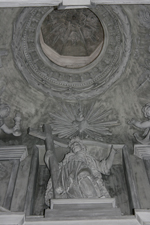
On the left side of the church, near the entrance, the Pociejai family chapel—a mausoleum—was added in 1783. Adjoined to the outer wall of the church, the chapel’s altar is a single-tier structure of plain artificial marble. Above it rises a low dome with a lantern, adorned with abundant stucco moldings. The primary iconographic motif of the chapel’s decoration is the theme of the Finding of the Holy Cross and the Passion of Jesus. Directly above the altar is the figure of St. Helena with the Cross; cherubs resting on the cornices hold attributes symbolizing Christ’s Passion and faithfulness to the Church—an anchor and the Host. Above St. Helena, a flaming heart is visible, echoing the motif of the heart burning with love for God that is emphasized throughout the entire iconography of the church.
The style of the chapel’s decoration is reminiscent of the ornamentation of the Gate of Dawn chapel from 1785–1787. According to art historian Marija Matuškaitė, both chapels may have been decorated by the same sculptor, Ignotas Gulmanas. In the chapel altar hangs an 18th-century figure of the Crucified, famed for its graces, which was gifted by the Lublin Discalced Carmelites in 1764. This figure was vividly described in a 1765 sermon by Maximillian Karpovičius, a preacher and theology lecturer for the Vilnius Discalced Carmelites.
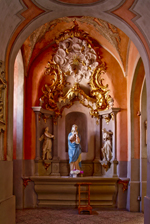
On the right side of the church is a small chapel of the Mother of God, featuring a single-tier Rococo (perhaps Neo-Baroque) altar and a vault decorated with frescoes.