

Since May 16, 2008, the community of the Vilnius St. Teresa Parish has invited the people of Vilnius and guests of the city to revive an old tradition—offering songs of gratitude to the Most Blessed Virgin Mary for her protection of Vilnius. In May, a month dedicated to the special veneration of the Mother of God, the “Prayer for the City of Vilnius” days are held at the Gate of Dawn.
How did the idea to revive this tradition arise? As Fr. Algirdas Toliatas, then vicar of the St. Teresa Parish and one of the main organizers of the celebration, told the daily Bernardinai.lt, several factors encouraged the restoration of these prayer days. Primarily, it was the desire to revive an ancient tradition born in the early 18th century. Following a great fire in the city, the people began celebrating a day of thanksgiving to the Most Blessed Virgin Mary every May 18th—orchestras would play various melodies, and hymns would be sung in her honor. Furthermore, this event serves as a response to the creation of the St. John Paul II Pilgrim Route and as a means to foster unity among Christians.
An Ancient Tradition of Gratitude
It is noteworthy that the tradition of gratitude to Our Lady of the Gate of Dawn emerged after a fire which, though not the greatest calamity in the history of Vilnius, resonated deeply within the hearts of the citizens. People of various ethnicities joined in. Records tell of the first solemn services held on May 18, 1706. Many residents claimed to have experienced the aid of Mary; some even maintained they had witnessed the Mother of God rising above the Church of St. Teresa and the Chapel of the Gate of Dawn to extinguish the flames. From that time on, a beautiful tradition was established: every May 18th, orchestras from across Vilnius would gather to play enchanting melodies for the Most Blessed Virgin from dawn until dusk.
“At that time, Vilnius was home to a very diverse society—Lithuanians, Poles, Jews, Germans, and Belarusians. The feast at the Gate of Dawn brought them all together; it was not solely a Catholic celebration. The event carried a very strong emphasis on unity and respect,” explained Fr. Toliatas. “Respect is much more than the tolerance we often speak of today. Everyone comes to the Mother of God to pray and to give thanks. Now, we are once again trying to invite everyone to join in common prayer and honor the Mother of Mercy.”
The Gate of Dawn – Part of the St. John Paul II Pilgrim Route
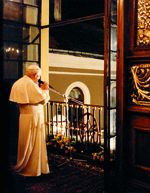
The St. John Paul II Pilgrim Route is currently being developed in Lithuania. In response to a request from the Lithuanian Bishops’ Conference, the Government approved a program to establish this route, which connects eighteen sacred sites visited by Pope John Paul II during his 1993 apostolic journey. One of these key sites is the Shrine of the Gate of Dawn.
“The Chapel of the Gate of Dawn was one of the first sanctuaries visited by Pope John Paul II upon his arrival in Lithuania. It was here that he entrusted his entire journey to Our Lady of the Gate of Dawn. He called us to open ourselves to the Third Millennium—a millennium of peace—and sought points of contact with others, focusing on what unites us rather than what divides us. Thus, we too must look for paths we can walk together with others,” said Fr. Toliatas. “This initiative by the St. Teresa Parish is perhaps another stone in the building of the St. John Paul II Pilgrim Route.” The priest believes this is a way to open ourselves and invite others so that “we can offer something authentic to visitors—a place where faith, humanity, and culture are truly lived.”
The Idea of Unity
“First of all, we wish to invite our own—the local Catholic parishes—to gather. We want to emphasize where our strength lies and what unites us. We face many challenges, alienation, and a tendency to close ourselves off; but closing off means death. Spiritual matters do not touch people as easily today because they are lulled by a comfortable life. Only by being united and living authentically can we survive,” the priest shared. According to him, Christianity began with a small group, and likewise today, Christians must gather and seek common ground—for instance, rather than highlighting tensions between different nationalities or denominations, we should seek shared points of contact.
Thus, one of the central aspects of the “Prayer for the City of Vilnius” celebration is the interconfessional and ecumenical service, where Christians of various denominations participate and a common blessing is bestowed.
Another vital element is the inclusion of people of various ethnicities. As in the past, this serves as a multi-national thanksgiving for the city—different nations coming together to praise God in their own ways. This reflects the same diversity and unity seen during the construction of the defensive walls of Vilnius: everyone brings their own stone, not measuring whose is larger, but striving together to protect against a common danger. “The defensive wall was built and later destroyed, but it must continue to be built if we wish to remain strong as a people and protect ourselves from enemies that destroy us from within,” said Fr. Algirdas.
The “Fire” of Our Times
According to the priest, the common danger of our day is lukewarmness, depression, oversatiation, inaction, and indifference. “This is the fire of our times—in the spiritual, human, and moral dimensions. A place where values vanish, where public theft is met with silence, and where everyone accepts it as normal without rising up. This is the fire of our Church, of Lithuania, and of our era.”
What can we do? We can contribute to the restoration of the symbolic defensive wall with a concrete action—a symbolic stone. “It may not be easy—we are different, a large orchestra that is difficult to tune into harmony. Yet these efforts are necessary, even if painful, because we have no other choice: either we survive together or we perish. We must not look only to our own benefit or that of our own parish, but attempt to do something together,” the priest reflected.
A Testimony of Martyrdom
Fr. Toliatas recalled a story shared by art historian Tojana Račiūnaitė: perhaps not many know that during the war years, a Carmelite priest at the Gate of Dawn hid Jews. They were eventually discovered and all were executed, including the priest. “To me, this is a beautiful and vital testimony—a Catholic hiding those of another faith. It is a concrete embodiment of the unity we wish to celebrate, to remember, and to emphasize. As the Pope said: ‘You are a nation of martyrs—do not forget your heritage.’ Such martyrdom is easily forgotten, and when no one remembers what was suffered, then trivial entertainment becomes our only legacy. In this way, we rob ourselves and scatter our greatest treasure,” the priest said.
Being Strong to Strengthen Others
According to the organizers, although this initiative takes place in Vilnius and is focused on its citizens, it is “not to separate ourselves, but so that by being together we might strengthen our unity, enabling us to respond to other events in Lithuania and to travel together elsewhere.” Unity and openness to other confessions, to different perspectives, and to other cities in Lithuania—this is the core vision of this celebration.
Prepared by Dalia Žemaitytė
Photos from the archives of the Vilnius St. Teresa Parish
Bernardinai.lt