

In the 17th and 18th centuries, Vilnius was ravaged at least twice by successive invasions of the Swedish and Russian armies. The capital of Lithuania was also devastated by fires. It was precisely after these assaults and fires that the Gothic city vanished, and Vilnius was transformed into a “pearl of the Baroque.” The people of Vilnius believed that their city was saved from total destruction by the protection of the Mother of God of the Gate of Dawn: she quelled the fires and, like the Ark of the Covenant in the Old Testament, relentlessly struck down the enemies who dared to despise her.

The intercession of Mary of the Gate of Dawn was sought not only in the face of fires and wars. After the final partition of the Polish-Lithuanian Commonwealth in 1795, most of Lithuania, and later the entire country including Vilnius, fell under Russian rule. Three uprisings (1794, 1831, and 1863) did not liberate either Poland or Lithuania, yet they demonstrated an unyielding resolve to regain freedom. Along with the persecutions following these revolts, devotion to the Mother of God of the Gate of Dawn grew even stronger. The sanctuary became a site for both religious and political manifestations. Members of the secret student societies of Vilnius, the Philomaths and Philarets, came here to pray. 19th-century literati of Vilnius who wrote in Polish but were also significant to Lithuanian culture—Józef Ignacy Kraszewski, Juliusz Słowacki, and Władysław Syrokomla (Ludvikas Kondratavičius)—contributed to the popularization of Mary of the Gate of Dawn. The famous Vilnius composer Stanisław Moniuszko wrote four solemn litanies for choir and orchestra for this sanctuary.
The Gate of Dawn gradually became a symbol of the struggle for freedom and statehood for both Poles and Lithuanians. After World War I, when the Vilnius region was incorporated into Poland, the paths of the two nations diverged for a time. Mary of the Gate of Dawn began to be referred to as the Protectress of the Eastern Polish Borderlands. Pope Pius XI, seeking to guard both nations from further division, did not wish for the Icon to be crowned with the title of Queen of Poland.
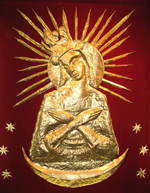
In the vast exiles and emigrations of both Poles and Lithuanians, the Shrine of the Gate of Dawn stands as a symbol of the lost homeland, and devotion to its Mother of God—as a sign of national identity and a pillar of hope. Lithuanians and former Polish residents of the Vilnius region, scattered across the world by wars, political upheavals, and poverty, chose Her as the patroness of their societies. They prayed for Her protection in refugee camps and Siberian exile, establishing churches dedicated to the Mother of Mercy wherever they were able. Lithuanian parishes of the Gate of Dawn were founded in New York (USA) and Montreal (Canada). Poles built such churches not only abroad; forced to leave the Vilnius region for Poland after World War II, they desired to have churches dedicated to the Gate of Dawn (e.g., in Warsaw), and at times even built replicas of the gate building itself, as was done in 1989 in a small town within the Diocese of Radom. In 1970, the Lithuanian Chapel was consecrated in the vaults of St. Peter’s Basilica in the Vatican, featuring a mosaic image of the Mother of Mercy of the Gate of Dawn, blessed by Pope Paul VI.
The persecutions that began with the Soviet occupation of Lithuania did not destroy the devotion to Mary of the Gate of Dawn. In 1948, a secret Lithuanian Catholic self-education society, the College of the Virgin Mary of the Gate of Dawn, was founded in Vilnius, which was later liquidated by security organs in 1950. After 1973, organized pilgrimages to the feast days began with the Friends of the Eucharist—members of an illegal Catholic youth organization. The youth of Vilnius parishes took turns reciting the Holy Rosary before the Icon of the Mother of God. On November 16, 1979, the Catholic Committee for the Defense of Believers’ Rights celebrated its first anniversary here. The members of the committee were greeted by youth who had traveled from various parts of the country.

After 1990, in an independent Lithuania where not only political but full religious freedom was restored, the Gate of Dawn became more of a focus for personal devotion. However, even today, it remains important as a place of spiritual resistance in a world touched by consumerist ideology and a confusion of values. Pilgrims streaming in from neighboring countries find the Gate of Dawn open to all who seek the protection of the Mother of God.